


We have officially entered Phase 2 — Outer Work — of the Sustainable Rhythm series.
In Article 6: The Paradox of Wisdom, AI, and the “LLM of YOU” we covered what happens when you partner your earned wisdom with AI and the power of creating a Large Language Model, or LLM, entirely of your own content. I call them living libraries and an LLM of YOU.
For six weeks, we did the Inner Work. We ran the Tried & New audit — what stays, what’s redesigned, what’s released. We reclaimed your earned wisdom and turned what remains into a living library. You came home to your own story first.
Now we step into the outer architecture: Found & Known. This is where your work goes out into the world.
But before we talk SEO, PR, podcast pitches, or speaking gigs, we have to clear up the biggest, most expensive mistake people make when they start seeking visibility: they think they’re the hero of the story.
Let’s First Address Who the Hero Is
You think you’re the hero.
You’re not.
Your audience is the hero. You are the guide.
You’ve already faced the dragon. You’ve already earned the wisdom. You’ve already come home changed. That was Phase 1 — the part of the work that was all about YOU. Now your job is to help your audience come home.
This isn’t a marketing trick or clever semantics. It’s the exact boundary line between strategic visibility that builds lasting relationships and random acts of marketing that exhaust you and produce nothing.
Most people don’t want to do this. They want the shortcut, the hack, the seven-step formula that promises results by Friday. But sustainable strategic visibility starts with deeply understanding yourself and your audience.
Know someone who would enjoy this article and series?
A Little Story About Real Connection
I recently had dinner with a good friend who’s a teacher. She has no connection to the online business world, and usually when I talk about my work, her eyes glaze over. So I rarely share what I do.
But this was different. Instead of the how or what I was creating, I told her stories about my clients and what they do.
She clung to every word. She wanted to know more. She cared about their stories. She remembered their names. Then she asked how I help them. I explained how I guide them through remembering and reclaiming what they already have. She looked at me and said, “You really do love this, don’t you? You cannot do anything else, can you?”
Suddenly she understood me at a level she never had before. Because I’d flipped the story. When you make it about the heroes on their journeys, everything changes. You’re not talking about the 100 points of your process — you’re inviting people to meet real people on real journeys they can relate to because they’ve been there too.
What Your Audience Actually Wants — Not What You Assume
The most underused strategy in marketing is also the simplest: listening. Not performing, not pitching — listening, first.
I learned this long ago, over twenty-five years on the admin side of large global law firms, watching new technology force change on an institution that wanted none of it. I had no direct line to decision makers for most of my tenure. But I had access — because I listened my way into it. Listening first became the foundation of my work today.
As I was preparing to launch this Substack, I put that discipline to use on my own archive. I fed an AI tool 145 Real 50 over 50 interviews, 18 panels, a year of weekly LinkedIn newsletters, and more than 100 files from a program I created and ran between 2009-2016 — not to write, but to listen and connect the dots over 20 years of my work.
That’s the same discipline you owe your audience: set aside what you assume they want, and listen for what they’re actually reaching for.
Beyond Demographics: Valuegraphics
To really understand your audience, throw out traditional buyer personas — “Mary the Manifesting Entrepreneur” doesn’t help anyone.
Instead, look at Valuegraphics, a concept from David Allison’s work. Demographics — “women over 50,” “six-figure earners” — tell you almost nothing useful. People of completely different ages, genders, and locations can care about the exact same things, or not. What people value is what drives their decisions, and it’s what they feel before they ever see or hear you.
When you deep-dive into your own values — I'm certified in Brené Brown’s Date to Lead curriculum and used her values exercise to narrow mine to Curiosity and Making a Difference — give it a try and align yours with what your audience values. When you hold what they care about as you create content for them, visibility gets easier. Aligned values act as a natural filter: aligned media covers you, aligned podcasts find you, perfect-fit clients seek you out, speaking opportunities resonate, and connections deepen organically because they’re built on something shared.
Revisit Article 3: Connecting with Your North Star & Core Values from this series to learn more about connecting with your values.
Your Curated Audience Is an Ecosystem
When most people say “audience,” they mean “prospective clients.” But a sustainable network is bigger than that — a living ecosystem you nurture and stay connected to:
Past clients who remember your work
Current clients living the transformation
Vendors who serve the same people you do
Media outlets and journalists who cover what you care about
Podcast hosts whose listeners are on similar journeys
Event planners curating communities you want to connect with
Strategic partners who understand your value
The lurkers who’ll never buy but love what you do and refer you quietly
Industry leaders, authors, and speakers who shape the conversation
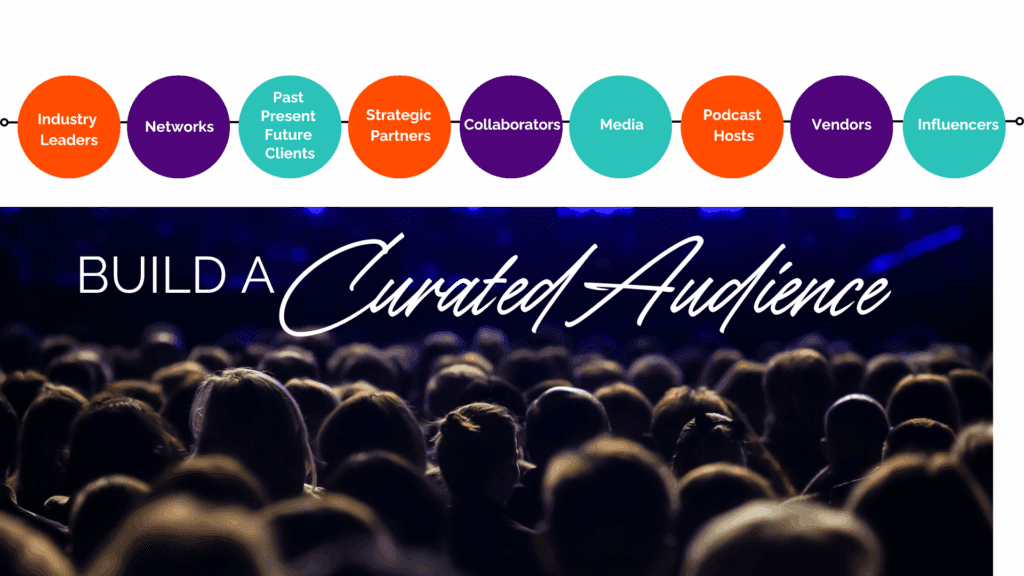
This is the intelligence-gathering work I organize in a simple spreadsheet I call the Brain Trust — key terms, podcasts, books, authors, all in one place so it becomes signal instead of noise. We’ll get into the mechanics of using it when we talk about PR and relationship-building later in the series. For now, what matters is this: you’re not researching your audience once. You’re building an ongoing relationship with who they are.
Building a Foundation That Lasts
This work is sustainable. Regardless of what platform is hot this month or what the algorithms do next, when you build your visibility on a deep, value-driven understanding of your audience, you create a foundation that is portable and moves with you.
That matters as we step into our third act — likely our last. We need something sustainable, flexible, and lit up by everything we’ve learned, not something dependent on a trend.
I’m living this. I originally wrote this series on LinkedIn, pouring years of thinking into it. Then LinkedIn changed its algorithm in ways that suppress organic reach — particularly women’s voices — and almost no one saw it. I wasn’t okay with that. So I did exactly what I teach: I took the work I’d already built and repackaged it. It became pillar content on my site, then the launch content for The Intentional Visibility Project on Substack — a platform I actually own. The foundation was already built. Moving it didn’t mean starting over. It meant strategic repurposing.
Listen First
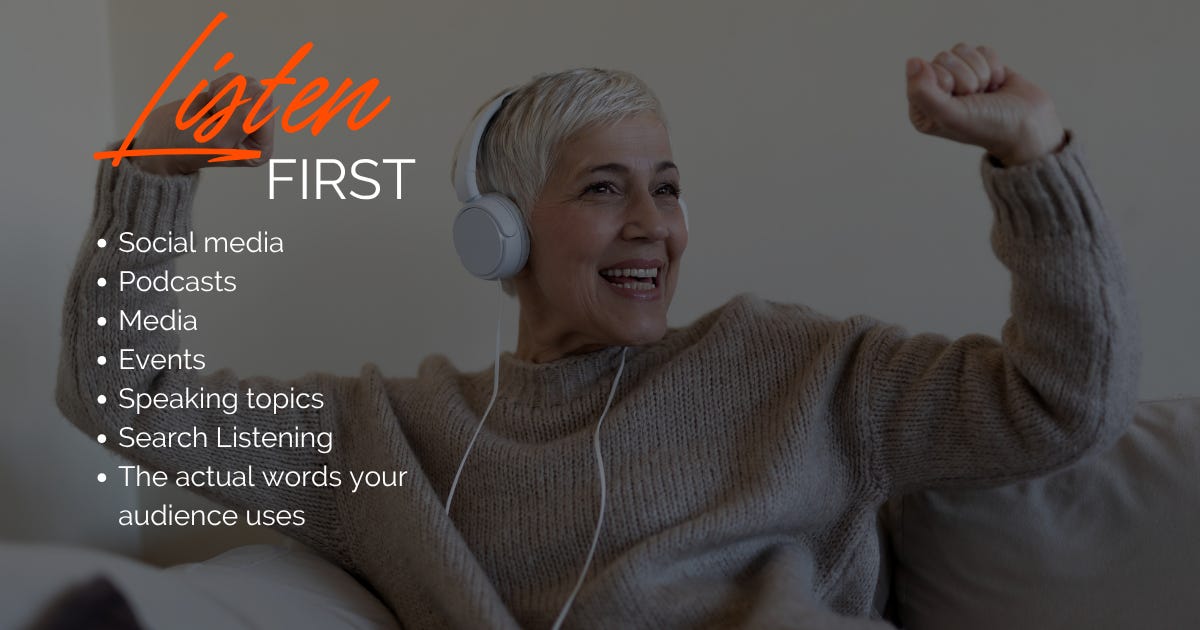
If you’re ready to do the deep, foundational work most people skip, start with listening.
Pick one real person who represents your ideal audience — not a demographic, a real human. Ask yourself:
Where are they on their hero’s journey right now?
What transformation are they seeking?
What do they value most?
Where do they show up online and offline?
What media do they consume?
What communities do they belong to?
What questions do they pose on social media?
What keeps them up at night?
What lights them up?
Don’t rush this. Don’t template it. Don’t delegate it to an AI tool or virtual assistant. This is the work that makes every podcast pitch, every website line, every offer easier and possible.
This is how we architect strategic visibility that matches the significance of your work. This is how you come home with your story — and help your audience come home with theirs.
Your Next Step
You’re not building the whole structure today. Open the Sustainable Rhythm Workbook to Article 7. Do the exercise.
I’d love to see what you find. Bring it to the roundtable. Next one is tomorrow, Thursday, August 20th, at 1pm ET. It’ll be intimate—which means you’ll have space to breathe, ask questions, and actually think aloud.
Next Tuesday, we start exploring being intentionally FOUND.
— Donna


