


If you’ve been following along this series, you may have spent some time thinking about your core values and North Star, two of the foundational layers that run through everything you create. With that foundation in place, curation becomes deliberate. This article covers what comes next.
What I’ve learned from redesigning my own life and business, working with clients, and interviewing close to 200 women on The Real 50 over 50 is that being told to reinvent ourselves pisses us off. Now that we have a bit of time and space, what we do want is to remember and reclaim what we already have. That is what the Tried & New process does.
Remembering and Reclaiming, Not Reinventing
Here is the pattern I’ve watched unfold. Women who are over 50, accomplished, and ready for what’s next are systemically told to either step aside or reinvent, through the media and organizations that hold our narrative.
The component that is not in this messaging is to first look at what you’ve accomplished, what you already have. The things we spent years putting aside for other people, personally and professionally — and somewhere in all that setting-aside, we lost track of how we got here.
We literally forget the 20, 30, or 40 years of professional growth and life that happened while we were keeping every ball in the air — as if none of it counts, as if it never happened. Then we look to someone else to give us the answers we already have.
No one is exempt. I did the research — uploaded more than 100 interview transcriptions and 18 panels from Real 50 over 50 and asked how many topics we discussed. 347. Then, what were the top 10? The number one topic was remembering and reclaiming. Reinvention didn’t make the top 10.
Tried & New doesn’t ask you to guess at what comes next. It’s an invitation to sift through what already exists and intentionally decide: what stays, what goes, and what else it can become.
The Audit No One Wants to Do
For years, I called this a content audit, because I didn’t have a better name for it. I didn’t truly understand it. Nobody wanted to do it — including me. And before AI became part of everyday work, it was a heavy lift.
Then I decided to redesign my business 3-½ years ago, and although I had gone through this process before, myself and with countless clients, this time was different — I was ready. AI helped me see patterns I couldn’t see on my own. The space I usually hold for clients. That’s when I named it, and when I understood it was so much more. But there was still some unfolding to do, and as I’m sure you know, that works on its own timeline.
The Unfolding, Over Time
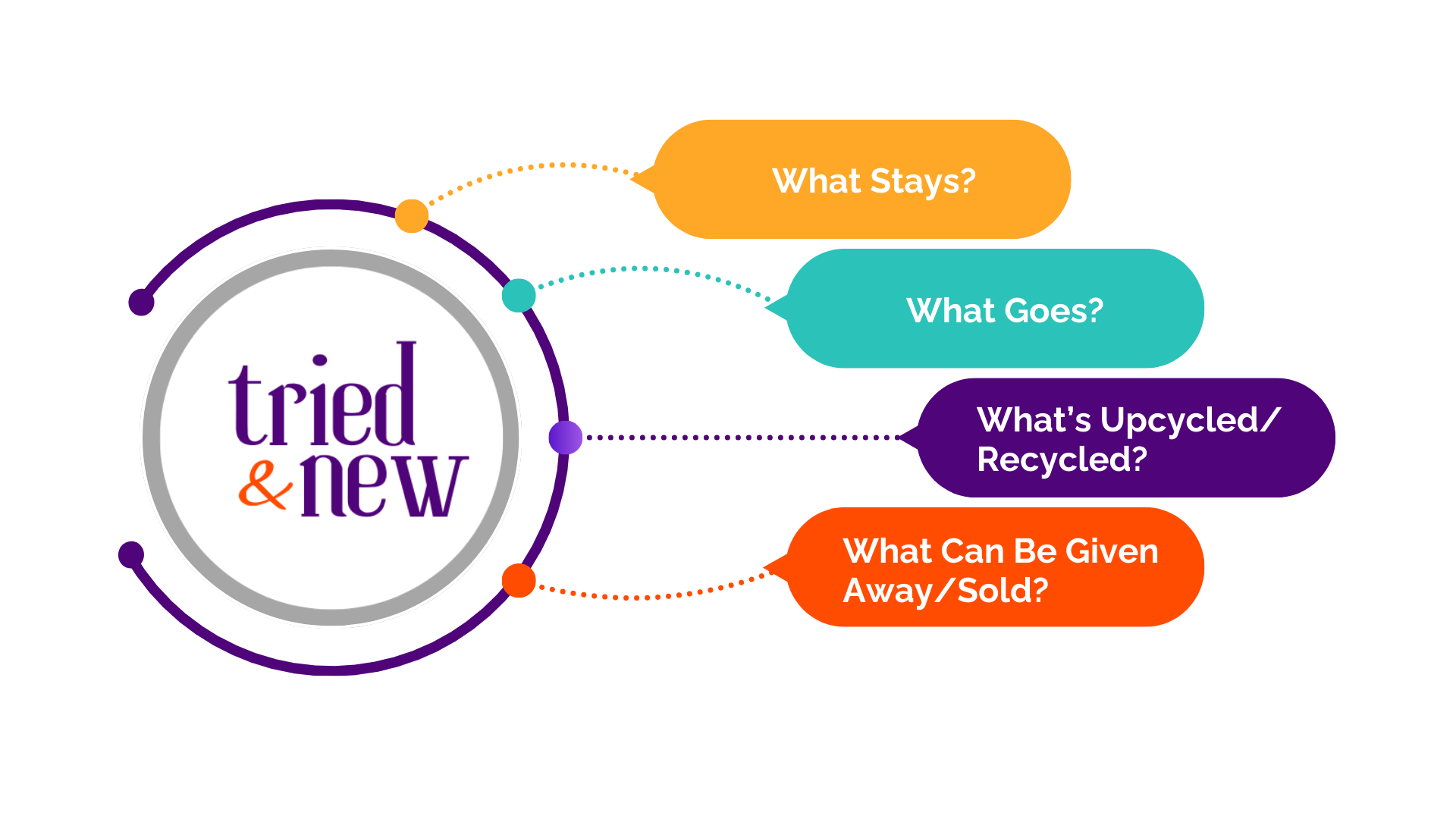
About six months into this unfolding, I found a show called The Gentle Art of Swedish Death Cleaning. It’s also a book, and a Swedish cultural way of honoring a life and creating ease for your family as you age. You go through your possessions with clarity and intention: What stays? What goes? What can be repurposed? What can be given away? What might have value to sell? This was the first time I saw my Tried & New process outside of my own work. It was a bit mind-blowing. Your content deserves the same consideration as you’re about to begin a new chapter. This is the solid ground of what comes next.
I’ve refined this process over the past three years, and I’ve watched it snap heads and change lives. It forces you to show up for yourself in a way you may never have before.
Know someone who would enjoy this article and series? Click below to share.
Where This Actually Comes From
As the unfolding continued… I felt my work and the work of those adopting this process spiral up into the outer work of visibility. But it also spirals down into the inner work of remembering and reclaiming. About two months ago, I saw the origin of this process.
I was a parentified five-year-old responsible, in real ways, for a household of five. Tried & New — the constant sorting of what to keep, what to let go, what to make do with — was my survival skill. I’ve done this throughout my life — it’s how I approach a project and a crisis.
The unfolding took me back to a skill I created to survive an impossible situation — then showed me how, over time, as I healed personally and grew professionally, it grew with me into a solid methodology that now helps women build businesses that change their lives, and ripple out in ways I don’t think I’ll ever fully understand.
That’s why this work has a rhythm to it instead of a formula. And it’s why it comes from the heart, not just from strategy.
One of my clients was poking around looking for content to launch her Substack. She found a series of 10 interviews she hosted 13 years ago featuring business leaders in her area. They’ve all gone on to do amazing things. When she first brought this up as an idea, she felt less than them. As she re-listened to these interviews with the intention of sharing their then-and-now stories and possibly lining up new interviews, she felt like they surpassed her. The part of this story that really lights me up? When she saw her own growth and recognized how much she has grown as a leader in 13 years. That is evidence she now has that will serve her more than she knows.
The Tried & New Process
It’s deceptively simple. Go through what you have — the blog posts, the talks, the drafts, the interviews, the frameworks you built for one client that quietly became your methodology — and ask:
What stays? The content that still represents who you are and where you’re going. The wisdom that remains true.
What goes? The content that no longer serves. The ideas you’ve outgrown. Let them go with gratitude for what they contributed and what they taught you.
What can be upcycled or recycled? This is where the magic happens. Good bones that need updating. Stories that matter but need new context. Frameworks that work but deserve a refresh. Don’t do the actual writing yet — pull together the ideas, and see where things naturally come together in a way you never noticed before.
What can be given away? Content that might serve others better than it serves you now. Knowledge you can share freely to build goodwill and relationship.
What can be sold? These are your services. Frameworks others would pay to learn. Experience that deserves to be packaged as a product or offer.
That last piece — what can be given away, what can be sold — becomes the raw material for your content planning and your services.
Going through this process doesn’t just organize your content. It reveals more about your audience. It shows you what both you and your audience care about. That becomes your content plan. It shows you exactly where the gaps are, and that’s the space for what’s new.
This Is Human Work, Not for Delegating to AI or Team
AI shows up in a bigger way later in the series, in the Found and Known articles — helping with discoverability and relationship: content creation, SEO/AEO/GEO, and PR. Here, in Tried & New, the work is human and personal. Deciding what stays and what goes is a decision only you can make.
What comes out of this sorting is what you eventually hand to AI — your actual experience, your history, your own words — so it can help you recycle and upcycle your own work into the foundation of what’s next. Skip this step, and you’re asking AI (or anyone else) to generate answers you already had inside you. You go back to giving away your value in the form of your history and your credibility. You end up building on borrowed material when you had a living library of your own earned wisdom to build upon.
This is inner work, and it’s continuous. You’ll do this again, because you’re always changing and growing, and the tools around you are changing faster than any of us can fully keep up with. That’s exactly why understanding those tools, and knowing how to communicate with them, matters — it’s what lessens the impact of constant change. Keeping your hands on the wheel, and leading with your own content and voice, is the foundation none of that turnover can touch.
Don’t Burn Down the Ships. Call In the Fleet.
As women over 50, we’re told that wanting something else means burning it all down and starting over. That message stacks on top of everything else already aimed at us — you’re not enough, everything you’ve done is irrelevant, what did you do to your hair, don’t eat that — and on it goes.
What if, instead of burning down the ships, we called in the fleet — hip-checked reinvention, and intentionally gathered what we already have?
When you go through Tried & New, you get to walk into your third act on the platform of what you’ve already accomplished. You witness your own body of work in action. You recognize patterns in your wisdom you couldn’t see before. You find evidence that silences imposter syndrome, because imposter syndrome doesn’t survive the love-bomb of a Tried & New process and shows those gremlins the door one by one.
This isn’t a content strategy. It’s an act of self-reclamation.
A Mixtape Is Not a Playlist
Here’s what’s next. In Article 5, we’ll talk about your content as the mixtape of your wisdom.
A mixtape isn’t a Spotify playlist. Back in the 1980s, when someone made you a mixtape, they cared about you enough to spend hours with a stack of songs and choose, track by track, what belonged. Tried & New is how you do that for yourself. It’s an act of self-love — caring enough about your own life and work to build a mixtape of you.

Let Your Body of Work Build Your Future
It doesn’t matter if what you have is a nearly-finished book, a course you set aside, or blog posts from five years ago. If it shaped who you are now, it’s valuable.
Instead of starting from scratch, you infuse your voice and experience into new formats, reach new audiences, and multiply your impact — by working with the living library of your earned wisdom you already have, instead of pretending it doesn’t exist.
The world is drowning in information and starving for wisdom. What you’ve learned through living matters. Curate it instead of abandoning it, and you bring forward something AI-generated content never can: true, earned experience.
That’s what the world needs from wise women. In the next article, we turn that library into a mixtape.
-Donna


