


I use a quote to open every PR training or conversation. It is from 1938.
“Advertising is what you pay for. Publicity is what you pray for.”
—Margaret Woodward, the first female advertising executive
Almost a century later, it’s still true.
PR is built on credibility, authority, relationships, and trust. Not sales. And certainly not whoever can send 1,000 AI-generated pitches before lunch.
Online noise equates visibility with being seen. But it’s better to be known.
You can be seen in a crowded feed and instantly forgotten. You can be featured on a podcast, quoted in an article, or invited into a room—and still leave no lasting impression if people cannot understand what you stand for, what you know, or why your work matters.
Knownability is different.
It is the accumulated recognition that comes when people encounter your ideas, stories, standards, and expertise consistently enough to understand you. They remember you. They recommend you. This is what makes them come back and mention your name in a conversation.
Known comes after Found for a reason.
Your Found work helps people discover you: through search, structured content, media links, guest appearances, recommendations, and the connected ecosystem of your work.
Your Known work helps them understand you once they arrive: through your point of view, your stories, your patterns, your generosity, and the relationships you build over time.
Intentional PR sits at the intersection of both.
What Changes—and What Does Not
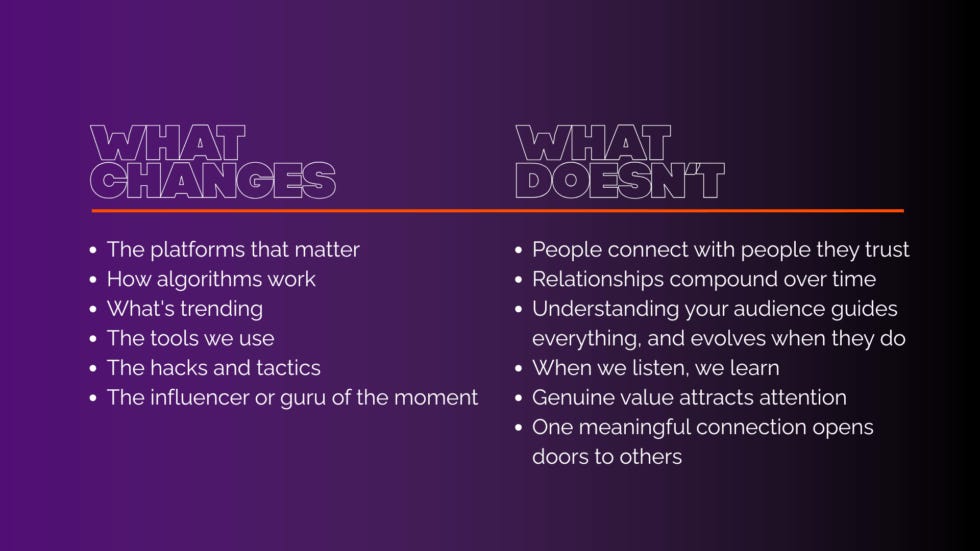
I have watched visibility strategies come and go.
I built the first phase of my business on Twitter. I went all in on Blab, until it disappeared overnight. I built elaborate listening systems in Hootsuite. I have watched platforms rise, fall, reinvent themselves, and demand that everyone chase the next trend.
I do not build my work around trends. I focus on the things that do not change, then build my relationship with technology and tools around those foundations.
Right now, how we are found is changing quickly. The best way NOT to get lost in that shift is to stay rooted in what has always mattered: credibility, relevance, generosity, preparation, and real relationships. That is how you build a foundation that can withstand change.
I have worked in PR since the mid-1990s, and one complaint has remained consistent—from journalists first, then podcast hosts: people pitch before they take the time to understand the work.
They go for speed.
Slow down. Build the relationship. Few people actually do this. When your thoughtful email lands amid all that noise, it stands out.
Show up prepared. Be the producer. Ask: “How can I help?”
Podcast hosts want thoughtful experts and guests who make their jobs easier and serve their audiences well.
Journalists want relevant, prepared sources who understand the story being told.
Event planners want speakers who can help them create a meaningful experience for the people in the room.
Community leaders still want collaborators who add value rather than arrive with their wallet open.
When you build your visibility around those things, you are not starting from scratch every time a platform changes. You are building a modern version of a priceless rolodex. A body of relationships that become part of your foundation.
These relationships turn into referrals for articles, interviews, and speaking. Do the math… over time, that means less pitching.
Relationship Media is an Inside Job
PR, podcasts, speaking, and relationship media are part of the Outer Work. They are how your ideas move beyond your own platforms and into other people’s rooms, communities, shows, publications, and conversations.
But the Outer Work is not where you begin.
Before you ask someone else to pay attention to you, you need to understand the work you are asking them to pay attention to and who it’s for.
That is why the Inner Work comes first.
Your intentionality gives you a reason for showing up beyond “I need more visibility.”
Your North Star and values help you recognize which opportunities are aligned—and which may look impressive but pull you away from the person and leader you are becoming.
Tried & New helps you gather the stories, lessons, accomplishments, pivots, perceived failures, and evidence that already live inside your body of work.
Your content mixtape helps you curate those pieces into a story that makes sense.
And your Living Library—the LLM of YOU—helps you return to your own words, identify patterns, and articulate what you already know, what you already have, without starting from a blank page every time an opportunity comes along.
This changes the quality of every outward-facing conversation.
You are not pitching a manufactured version of yourself. You are not trying to invent a new point of view because a host, journalist, or event planner asks what you talk about.
You are prepared.
You have done the work to know what you stand for, what you have lived, what you can contribute, and who you are here to serve.
That is the difference between chasing visibility and building knownability.
When the Inner Work is solid, the Outer Work becomes easier. You can listen more carefully, choose opportunities more intentionally, and show up with the grounded confidence of someone who is not trying to become credible in public.
You are revealing credibility that already exists.
PR Is Where Found + Known Meet
In the previous article, I wrote about Found: the structural side of visibility.
Search is no longer just Google. People look for answers through AI platforms, search engines, podcasts, YouTube, LinkedIn, Substack, communities, referrals, and the endless trail of links, mentions, interviews, and recommendations that make up the modern web.
Your own content matters. Your website matters. Your structured articles, clear headings, internal links, author pages, and technology matter.
But your work does not live only on the platforms you own.
One of the three paths of discoverability is off-page SEO: the reputation layer. It includes mentions, backlinks, guest features, podcast interviews, media coverage, reviews, and the many ways other people reference your work.
This is where PR creates new structural advantages.
Earned media has always built credibility. A respected host, journalist, publication, event, or community leader choosing to include you says something you cannot say about yourself. It is third-party validation. It is a warm introduction to an audience they have carefully curated.
Today, that validation also creates public evidence.
Found helps someone discover your name, your content, or your conversation.
The trusted platform lends the introduction. Your point of view, stories, standards, and consistency are what help people remember you, trust you, and return.
This is not an argument for collecting logos, appearances, or buying random backlinks.
A mention without relevance does very little. At best, it adds noise. At worst, it muddles the pattern you are trying to build around your expertise.
The goal is not to be everywhere.
It’s to build a coherent pattern of credible, connected evidence around the work you want to be known for.
That is the dance.
Found helps someone discover your name, your content, or your conversation.
Known adds credibility and authority by introducing you from a platform your desired audience already trusts. That triggers remembering and brings them back.
The Difference Between Pitching and Relationship Architecture
There are two very different ways to approach PR and visibility opportunities.
The first is built on volume and speed.
Create a pitch template. Teach an AI to send it to 100 podcasts. Land a few interviews. Share each appearance once. Move on to the next batch. Repeat.
It is hollow and transactional. And entirely misses the most valuable part of media relations. It treats the person with the platform as a gatekeeper standing between you and the audience you want.
For years, I have followed the conversations and reports about what journalists, hosts, and producers say they want from the people pitching them. The answers are remarkably consistent:
Understand what they cover
Respect their deadlines
Be prepared
Bring a relevant point of view
Be kind
That last one always gets me.
It reveals how many people still misunderstand PR. They treat it as free advertising, rather than recognizing the value of a relationship with someone who has spent years earning the trust of the very audience you hope to meet.
And letting AI become your first impression with someone who could warmly introduce you to the audience you spend half your time trying to reach misses the boat entirely.
Use AI to research, organize notes, prepare, and preserve what you learn. Do not use it as a substitute for genuine connection.
I invite you to rethink this approach.
It begins with listening. It leads with a warm introduction, genuine interest, and thoughtfulness about how you can make someone’s work easier or their conversation stronger.
You do not arrive asking, “How can I get in front of your audience?”
You ask, “What are you building here, and where might I genuinely contribute?”
If you want to be on the podcast, listen to the podcast and tell the host how you can help their audience. If you want to be featured on a media platform, understand the format. In your pitch, share the section that best fits your expertise and pitch the right person.
That is how you stand out above the noise and build relationship architecture.
It takes longer. It requires more thought. But it creates results that compound for years.
Listening Is the Relationship Architecture
The Four-Way Listening Barometer sits underneath every relationship decision in this methodology.
Before you reach out to a host, journalist, event planner, author, speaker, or community leader, listen in four directions.
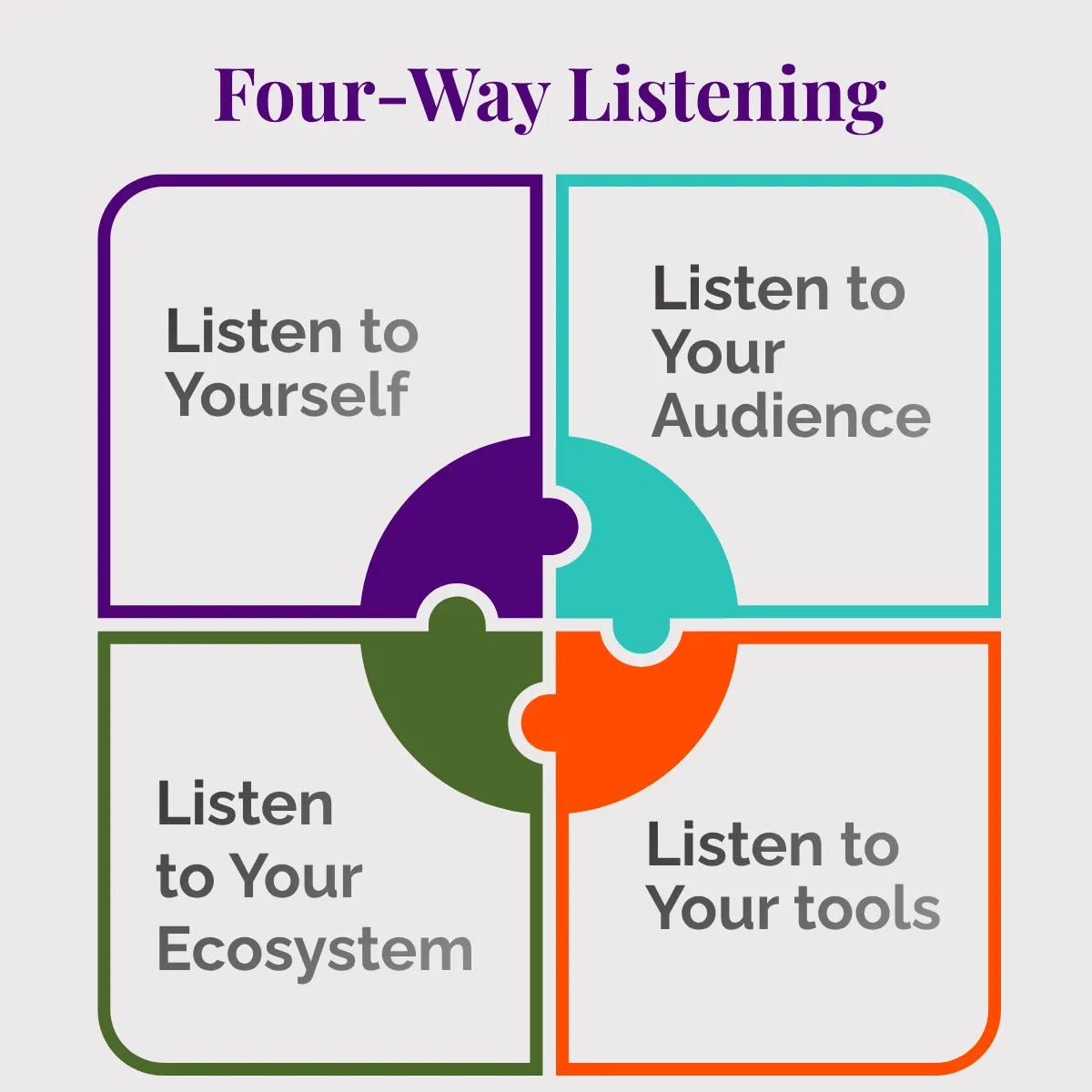
Listen to yourself
What do you genuinely have to say?
Your North Star, values, Tried & New work, content mixtape, and Living Library help you recognize the patterns in your own body of work. They keep you from inventing a different version of yourself for every opportunity.
Before you ask to enter someone else’s room, know what you want to contribute and why it matters.
Listen to your audience
What are your people trying to understand, solve, name, or change?
This is where knowing what your audience values come in. Listen for fears, desires, questions, language, and lived experiences—not merely demographics.
That understanding helps you identify conversations where your work can genuinely serve.
Listen to the people you serve specifically
Not every opportunity is for you.
A large audience is not automatically the right audience. A prestigious platform is not automatically an aligned platform. Knownability is not about being known by everyone. It is about being deeply understood by the people for whom your work matters.
The clearer you are about those people, the easier it becomes to decide where to invest your time and energy.
Less is more. Even now.
Listen to the places you want to be
This is the relationship-building side of research.
Listen to several episodes of a podcast. Read a publication’s recent work. Watch how an event is being positioned. Notice the themes a community returns to, the guests who resonate, the stories that matter, and the problems the host or organizer is trying to solve.
Then ask:
What conversation are they already having?
What does their audience come there to receive?
What might I contribute that is useful, specific, and true to my work?
How can I make this person’s work easier, stronger, or more valuable?
This is not manipulation. It is respect.
And respect is often the beginning of a good relationship.
The Four-Year Client
Let me tell you about a podcast interview that continued to bring me clients four years after it was recorded.
It did not go viral. The show did not have millions of listeners. The episode was about Twitter strategy—a subject that, on the surface, could have become dated quickly.
But I did not treat that 45-minute conversation as a one-time appearance.

I stayed connected to it. I repurposed the ideas into multiple pieces of content over time. I tagged the host and let her know how much I valued her show and our conversation. I chose ideas that would remain useful beyond the immediate platform tactics. The host later used highlights from the episode as part of a “Summer of Social Media” series featuring several experts.
Years later, someone found me through a social post I had scheduled about that conversation.
That interview kept working because it didn’t disappear after the original publish date. The ideas were still useful. The relationship with the host was still alive. The content was still connected to the larger body of work I was building.
And when someone found that conversation years later, they did not simply see my name. They encountered enough context to begin understanding how I think and what I help people do.
That is not a story about squeezing every possible drop of content from one interview.
It is a story about keeping a valuable conversation alive.
The relationship with the host mattered. The audience mattered. The ideas still mattered. And because I kept sharing the work with care, people could still find it—and begin to know me through it—long after the original recording date had passed.
That is relational visibility. That is knownability in action.
And that Twitter strategy from so many years ago… I recently used my Tried & New process to upcycle it into a Substack connection strategy. I focused on the parts that do not change. Listening and building relationships.
One Conversation Can Build Both Found and Known
When someone lands a podcast interview, they often record it, wait for it to air, share it once, and move on.
But a meaningful conversation can become part of the larger architecture of your work. That’s where AI becomes a great partner.
When you preserve and revisit a good conversation, you are not trying to squeeze every possible drop of content from it. You are recognizing that one thoughtful exchange can serve multiple purposes: it can deepen a relationship, reach a new audience, add to your public credibility trail, and become reusable material inside your own Living Library.
It can become:
A transcript you return to when you need content ideas or language you have already said well
Multiple social media posts shared over months or years
Blog articles or Substack essays that expand on topics discussed
Email sequences to your own audience
Quotes and soundbites for future use
A workshop, roundtable, or series of articles
Reference material for future pitches
An ongoing conversation with the host’s audience
Relationship maintenance with the host themselves
A credible third-party reference that helps the right people discover you later
A public example of your expertise, voice, and point of view—another way people can begin to know you before they meet you
One 45-minute conversation can become months of meaningful content. More importantly, it can become an ongoing thread in how people understand you.
You are not simply trying to be booked.
You are building evidence of who you are, what you think, and how you serve.
A fresh podcast interview is also full of self-insights. You will often say things in the flow of a conversation that you don’t remember or are not fully aware of yet. I put the transcript of every new podcast interview into an AI tool and ask it to pull soundbites. Give it a try and let me know what you learn about YOU.
Partnership Rather Than Pitch
Here is what shifts when you approach PR this way:
Podcast hosts become partners in serving audiences you both care about, rather than gatekeepers you need to convince
Event planners become collaborators building valuable experiences, rather than decision-makers you need to impress
Journalists become colleagues with deadlines and needs, rather than intimidating figures you are trying to crack
Authors and speakers become potential collaborators who serve similar audiences, rather than competitors to outshine
Community leaders become co-creators of value, rather than exclusive clubs to break into
The energy changes entirely.
You are not performing or pushing. You are connecting and contributing.
Partnership does not mean you never make a request. It means the request is made in context. You have listened. You understand the person, their work, and the audience they serve. You know what you are offering. And you are prepared to treat the interaction as the beginning of a relationship rather than a transaction you complete and abandon.
People remember the person who showed up prepared, understood the assignment, served the audience, and made the experience better.
They remember the person who treated the relationship as a relationship.
This is where it turns into word-of-mouth referrals for more interviews, and it does lead to sales.
Where to Begin
If this approach resonates, start with one relationship.
Not ten. Not fifty. One.
Choose one podcast, publication, event, or community that genuinely aligns with your work and the people you serve. Listen before you reach out. Notice what they value. Learn what makes a strong contribution in that particular space.
Then let your outreach emerge from real understanding rather than a template.
If the opportunity happens, treat it as the beginning of a relationship—not the completion of a task.
Show up prepared. Be generous. Serve the audience. Make the host’s or organizer’s work easier. Capture the conversation. Return to it. Share it with care. Keep the thread alive.
One strategic relationship built with care can create more lasting visibility than 100 random pitches.
More importantly, it can create the kind of recognition that matters: the right people knowing you well enough to remember you, recommend you, and invite you into the next conversation.
And keep track of your outreach. Use a spreadsheet, CRM, project-management tool, Notion—whatever fits with your existing systems, and you will actually use.
Track the name, show, publication, outlet, notes from your research, whether they responded, questions they asked, and the people or opportunities they mention.
Media databases can be expensive. You do not need 100,000 media contacts. Build your own relationship list as you go. You only need a few good connections to make a difference.
This Is Not an Add-On
PR, podcasts, speaking, and relationship media are part of the Outer Work. They are how your ideas move beyond your own platforms and into other people’s rooms, conversations, communities, and search ecosystems.
But this is not where you begin.
The Inner Work comes first for a reason. Your intentionality, North Star, values, Tried & New process, content mixtape, and Living Library give you something real to bring into those conversations. You are not manufacturing a new version of yourself for every pitch or opportunity. You are learning to articulate the body of work that is already there.
Then the Outer Work begins.
In Article 7, we turned toward your audience, the people you serve and the questions, values, fears, and language that shape their decisions. In Article 8, we looked at Found: the content, structure, platforms, search pathways, and credibility signals that help people discover your work.
This article is about being Known.
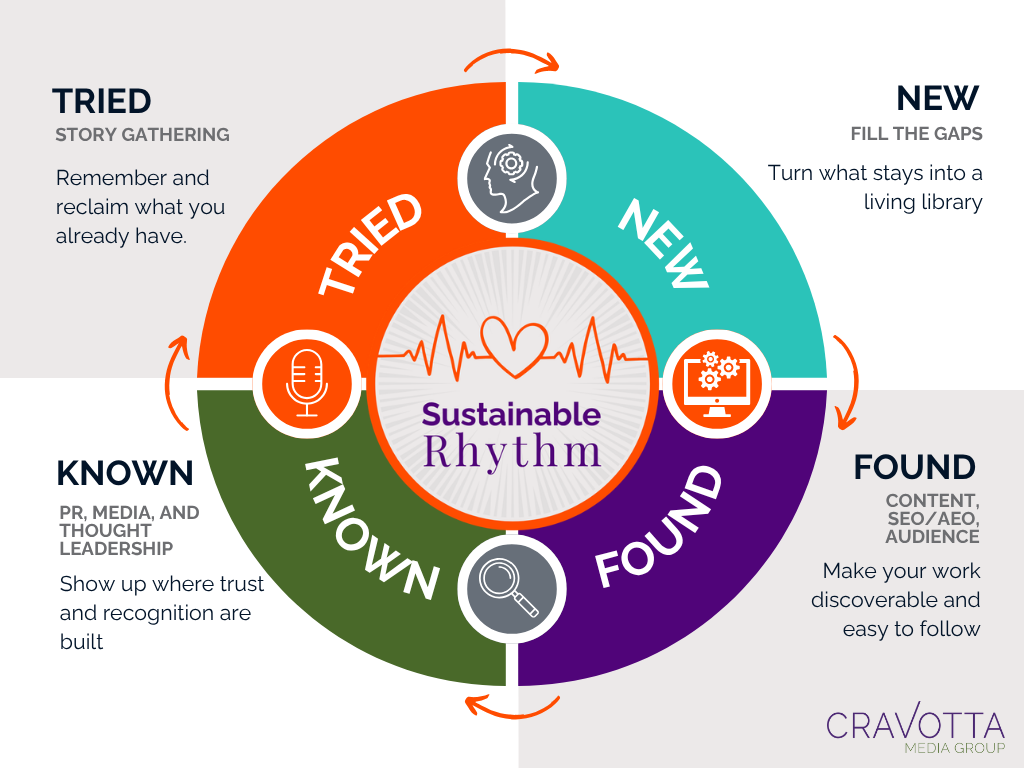
PR and relationship media are where Found and Known dance together. A good interview, article, speaking engagement, or introduction can help someone find you. But your stories, point of view, standards, and the relationship you build are what help them understand you, remember you, and know when to bring your name into the room.
That is knownability.
The goal is not to be everywhere. It is to be known in the places where your work can be understood, trusted, and carried forward.
In the final article, Connecting the Dots, I will bring the full methodology together and show how all nine pieces become your Strategic Compass: a way to decide where to show up, what to say yes to, and how to keep building a body of work that speaks for you even when you are not in the room.
-Donna


