


In Article 2, we talked about architecture — the foundation that has to exist to hold everything else up. This week, we'll name two main components of the foundation: your North Star and your core values.
These aren’t just words for a vision board.
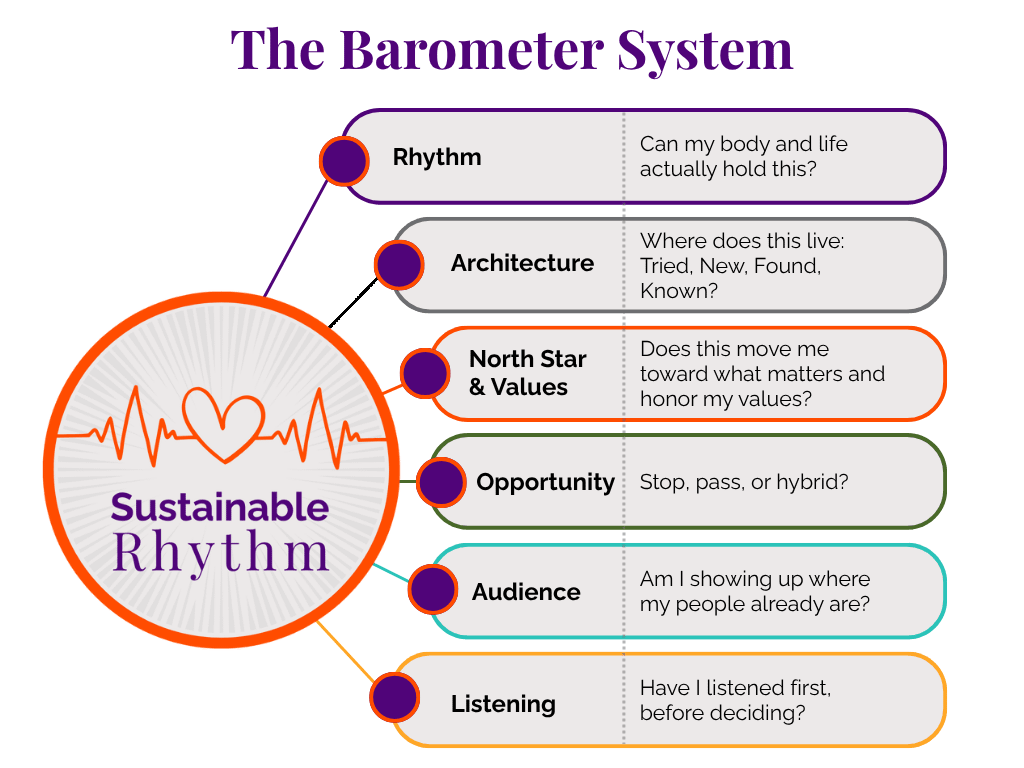
They’re your barometer.
That measures your offers, platforms, or opportunities.
Values aren’t something you give off.
They’re something you build with.
Your North Star creates a path for who you can become.
This is the layer that changes everything.
Together, they hold you accountable to YOU.
What is a North Star?
Your North Star isn’t a mission statement, and it isn’t a fixed identity you adopt. It’s a reference point — a person, or pieces of different people, real or not yet met, someone you already know or someone entirely made up, or a piece of the future version of you.
You have to see it to be it.
The question isn’t “who do you want to be like.” It’s: who is the person or organization you’d most want to notice you — to have follow you, recognize you, know that you exist? And why? Then reverse engineer it so it comes back to you.
That “why” is the real answer. It’s rarely about the person. It’s about the qualities they represent that you admire. That you would want to see how they fit for you.
This isn’t a one-time exercise. Spoiler alert… most of my work is not. As we change and grow, so do the things we want. The process doesn’t resolve into a tidy sentence and a checked box. It keeps going — you keep refining your reference point as you grow, until eventually the reference point is you. You become your own North Star. That’s the actual destination, not a single moment.
This is my North Star — the core group. There are layers beyond this too.

You may be familiar with Martha Beck’s book and methodology “Finding Your North Star.” This is different.
It’s Not About Copying Someone
When I bring this, I’m often met with resistance. In this exercise, the word “Emulate” does not mean to try and be someone else. It’s about noticing why it works — the structure underneath it, not the surface of it. The intention is to understand the part of them that you admire so you can try it on like clothing and see if it fits the rest of your parts.
The three-step framework itself comes from an unlikely place: USC’s Thornton School of Music, by way of a Mel Robbins podcast episode I have listened to and shared a lot.
Emulate. Name one person, era, or future version of your own work that genuinely moves you. Not their identity — their qualities. What do they actually do that stands out?
Assimilate. Take those qualities apart. Where do they already show up in your work? Where don’t they yet? Try them on. See how they actually feel, in your life, in your work right now — not in theory.
Innovate. Keep what genuinely fits. Let go of what doesn’t match your reality, your rhythm, your values. Layer it onto what you already have, and let it sharpen your reference point for this season.
Then you start again. That’s not a flaw in the process — the process is the work. Your North Star gets clearer each time you run it, not fixed once and filed away.
Listen to Mel Robbins podcast-episode 71. Actually listen to it, don’t skim the summary. This one’s better heard than read, and doing the work makes everything else easier. The time is an investment.
Values Are What Hold You Up When Things Get Hard
Brené Brown says…
“your values are what give you strength when you’re in the arena. Not when things are easy. When they’re not”
Most people can rattle off a value or two if you ask them. Fewer can tell you what that value actually looks like in a bad week — when you live your values, they come right up and support you, help you make hard decisions, or guide you through a difficult conversation.
Mine are curiosity and making a difference. The fun parts are easy, I’m curious I like to learn and find new things and ways of working. The Real 50 over 50 is my making a difference in action. It’s a lot of work, but it’s work I cannot not do.
On the flip-side, when things are hard, my curiosity goes MacGyver level and has saved my ass more than once. And the making a difference, that I approach two different ways. If it’s a situation I can change, I challenge myself to find a way. If I cannot change the situation, I do a random act of kindness to balance the universe. It will come back to someone in some way, maybe even me.
Here’s the thing about narrowing to your core values: it’s another process, not a checklist you fill out in ten minutes. Brené’s own exercise starts with a long list and asks you to keep cutting until you’re down to two. That cutting is the exercise. Listen to the podcast episode in the Dare to Lead Hub on her website. She explains it beautifully. If you’re at five… keep going.
I’m certified in Dare to Lead, which includes this values work directly. The full exercise is available on Brené’s site: Living Into Our Values.
This is not easy breezy work. But I can say with 100% certainty that doing the work is worthwhile. You will learn things about yourself you do not know now. And having your values in your hip pocket when you need them is invaluable. Sit with the full list, cut it down for real, and get to the two that are left when you stop protecting yourself. For each one, get specific is it a value or something you do? What does living it actually look like? What does drifting from it look like, when you’re tired or scared or rushed? And when has it been fully, visibly true — a real moment, not a mission statement?
That specificity is what makes a value more than an adjective.
Know someone who would enjoy this article and series? Click below to share.
Putting the Barometer to Work
Once you’ve named your reference point and your two values, the test is simple. Look at what you’re already doing — your offers, your content, your platforms, your pace — and ask where it’s actually pointed toward that North Star, and where it’s quietly drifting toward someone or somewhere else.
You don’t need to fix everything you find. Pick one adjustment. That’s enough for now, get accustomed to the process so you can use it again and again. .
Barometers in play: North Star & Values.
Your Next Step
Open the Sustainable Rhythm Workbook to Article 3. Carving out some time to name your North Star and do the real values work is what moves this from an idea to something you can actually use.
That’s it. You’re not building the whole structure today.
I’d love to see what you find. Bring it to the roundtable. First one is this Thursday, July 23rd, at 1pm ET. It’ll be intimate—which means you’ll have space to breathe, ask questions, and actually think aloud. If you’re in the thick of the values work (and maybe cutting it down to two) or working through who belongs in your North Star roster, bring it with you. I’ll help you sort it out live.
Next Tuesday, we start exploring Tried & New and what happens when you look at your collective content with a discerning eye.
Don’t burn down the ships… call in the fleet.
— Donna


