


How Tried & New + Found & Known Becomes Your Strategic Compass
There is a woman we met at the beginning of this series.
She has decades of work behind her. A body of knowledge that is genuinely rare. A track record that speaks for itself—if you know where to look.
She has built, led, survived, learned, created, and shown up for everyone else.
And yet, she is not as known as she should be.
Not because she lacks expertise. Not because she has nothing worth saying. Not because she needs to become someone new.
She is not starting from a blank page.
She is standing in front of a lifetime of work—stories, skills, accomplishments, mistakes, pivots, ideas, client breakthroughs, perceived failures, and wisdom she may not even realize she carries.
The problem is that much of the visibility advice offered to women like her was never designed for someone of her caliber.
It tells her to post more. Reinvent herself. Chase the algorithm. Pick a niche overnight. Make louder content. Become a brand.
It asks her to burn down the ships that carried her here.
I disagree.
You do not need to burn down the ships.
You need to call in the fleet.
That is what this series has been about.
Over ten articles, we moved from the Inner Work of remembering, reclaiming, and understanding your body of work to the Outer Work of helping the right people find you, feel themselves in your content, trust you, and come back.
Each article stands on its own, yet it is part of a system. One that self-propels as you connect the dots.
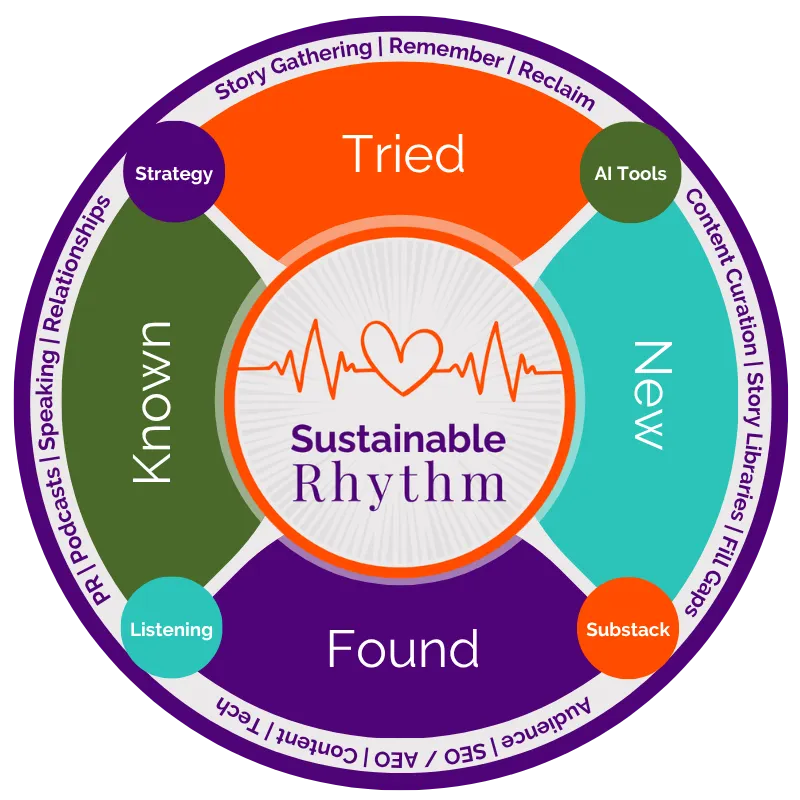
You become the cartographer of what comes next. This methodology becomes your Strategic Compass.
This Is Leadership, Not Marketing
At the beginning of this series, I shared that this work is not marketing. It is leadership.
Here is why…
Marketing, as it is often taught, asks: How do I get attention?
Leadership asks: What do I stand for? Who is it for? Why does it matter? What is the impact?
Visibility for its own sake doesn’t last.
It becomes sustainable when it’s intentional and built specifically for someone who feels understood and cared for. Your values and taste are recognizable in your work.
Look beyond the tactics of posting schedules and automated creation. Build something that matters to the people you want to make a difference for.
The people I work with are not typically marketers. They are leaders who market because it makes the work possible.
What if we flipped the story and created content that could actually hold our leadership?
The Order Matters
The methodology is arranged in two parts: Inner Work, then Outer Work.
This approach is not linear. It’s cyclical.
You will return to different parts of it again and again. An audience question may send you back to your stories. A new opportunity may bring you back to your North Star. A tech issue may expose a gap in your architecture.
But you need to build the foundation first, in order.
I’ve watched too many people begin with the final step.
They hire someone for SEO before they know what they need to be found for.
They pursue podcast interviews before they know what they want to be known for.
They create more content before they have gathered the material already sitting inside their own body of work.
They build a new website before they have made decisions about the ideas, stories, offers, and relationships that website needs to hold.
Then they wonder why it doesn’t work.
It feels hard because the outside cannot organize what has not yet been understood on the inside.
The Inner Work answers the questions that arise when you embark on the Outer Work.
The Outer Work holds the first impression people have of your work. You only get one.
The Inner Work: Calling in What Is Already Yours
The first six articles were about the work that happens before you ask the world to pay attention.
Intentionality creates a sustainable rhythm
In Article 1, we started with intentionality.
Not goals written because someone said you should have them. Not more content for the sake of looking active. Not a business model that requires you to override your own capacity.
Intentionality asks:
What am I building now?
What does a sustainable version of this work look like?
What do I want my visibility to make possible?
What must change so the work fits the life I am actually living?
Without intentionality, visibility becomes another demand.
With it, visibility becomes a way to lead.
Architecture gives the work a place to live
Article 2 introduced the idea of architecture.
Your work needs more than good ideas. It needs a structure that can hold those ideas over time.
Your content, platform, stories, offers, relationships, technology, and future plans cannot all live as disconnected pieces. Architecture helps you see what belongs together, what is missing, and what needs to be strengthened before you pile on more.
You are not building a content machine.
You are building a thought-leadership platform.
Your North Star and Core Values help you decide
In Article 3, we looked at the North Star and Core Values.
The North Star is not about copying someone else’s success. It is about paying attention to the qualities, standards, and possibilities that move you.
Your values are not decorative words for a website. They are the standards you return to when an opportunity looks shiny, when the work gets difficult, or when you need to remember what matters.
Together, they become a barometer.
They help you recognize the difference between an opportunity that expands your work and one that pulls you away from yourself.
Tried & New helps you reclaim your body of work
Article 4 was about Tried & New.
This is where you gather the scattered evidence of your life and work and decide what stays, what goes, what can be upcycled, what can be given away, and what can become an offer.
It is a content audit, yes.
But it is also an act of reclamation.
You are not revisiting old work to prove you were once valuable.
You are looking for the threads that are still alive—the wisdom, stories, patterns, and frameworks that can serve what comes next.
Tried & New is the opposite of reinvention for reinvention’s sake.
It says: start with what is true. Then decide what is new.
The content mixtape tells the story
In Article 5, we moved from gathering to curating.
Your content is not a random collection of posts, presentations, interviews, and documents. It is the mixtape of your wisdom.
A real mixtape was never random. Every song had a reason to be there. The order mattered. The transitions mattered. The person making it was trying to say something.
Your mixtape does the same.
It helps you choose the stories, language, proof, and themes that tell the clearest story of your work—not the story you think you are supposed to tell, but the one that is already emerging from what you have lived.
The LLM of YOU helps you keep your own voice
In Article 6, we explored the Living Library and the LLM of YOU.
AI does not replace your wisdom. It can help you retrieve it.
When you gather your own writing, interviews, stories, transcripts, and materials into a thoughtful private library, AI can act as a librarian. It can help surface a phrase you have used repeatedly, connect a current idea to something you said years ago, identify patterns, and help you begin with your own words rather than a blank page.
The tool is not the point.
The point is that your body of work is now accessible to you.
You are not asking AI to invent a voice. You are using it to help you hear your own more clearly.
The Outer Work: Letting the Right People Find and Know You
Once the foundation is clearer, the work turns outward.
This is where people often want to begin. And of course, it is where many of us need to go.
But when it follows the Inner Work, it becomes more grounded, more strategic, and much less exhausting.
Your audience is the hero
Article 7 turned the attention toward the people you serve.
You are not the hero of this story.
Your audience is.
Your role is to understand their questions, fears, hopes, values, language, and lived experience deeply enough to become a useful guide.
That is why demographics alone are not enough. You need to understand valuegraphics: what people care about, what they fear, what they are trying to become, and what they may be searching for privately at 2:00 in the morning.
It reminds you that content is not about broadcasting what you want to say. It is about creating a conversation that helps someone feel seen, understood, and less alone.
Found makes your work discoverable
Article 8 was about being Found.
Found is the structural side of visibility: your website, content, search, AI discovery, technical health, internal links, platform pathways, and the patterns that help people—and the systems now shaping discovery—understand what your work is about.
Search is no longer a single destination.
People search in Google, ChatGPT, LinkedIn, YouTube, podcasts, Substack, Reddit, communities, and in the quiet moments after a friend says, “You should talk to Donna.”
That means your entire body of work matters.
The goal is not to post more and hope.
The goal is to understand the questions your people are asking, use language they recognize, and structure your content so it can be found when it is needed.
Found is still audience work.
It is listening made visible.
Known makes your work memorable
Article 9 was about Known.
Being found is important. But being found is only the beginning.
Known is what happens when people encounter your stories, ideas, standards, and expertise often enough to understand you. They trust you. They remember you. They recommend you. They know when to bring your name into the conversation.
This is what I call knownability.
PR, podcasts, speaking, guest articles, collaborations, community, and relationship media are where Found and Known begin to dance.
A trusted host, journalist, event organizer, or community leader can introduce you to people who may never have found you on their own. That third-party context helps create credibility and discovery.
But the relationship itself is what creates knownability.
You do not need to be everywhere.
You need to be known in the places where your work can be understood, trusted, and carried forward.
Your Strategic Compass
When you bring these pieces together, they stop feeling like a list of things you should be doing.
They become a series of barometers. A way to decide.
An invitation comes in.
A new platform launches.
Someone asks you to collaborate.
You have an idea for an offer.
A client asks you to do something outside the scope of your work.
You are tempted by a shiny new tool, a new channel, a promising partnership, or a chance to be in a room you have wanted to enter.
Instead of asking, “Should I do this because I might miss out?” Bring it to the barometers.
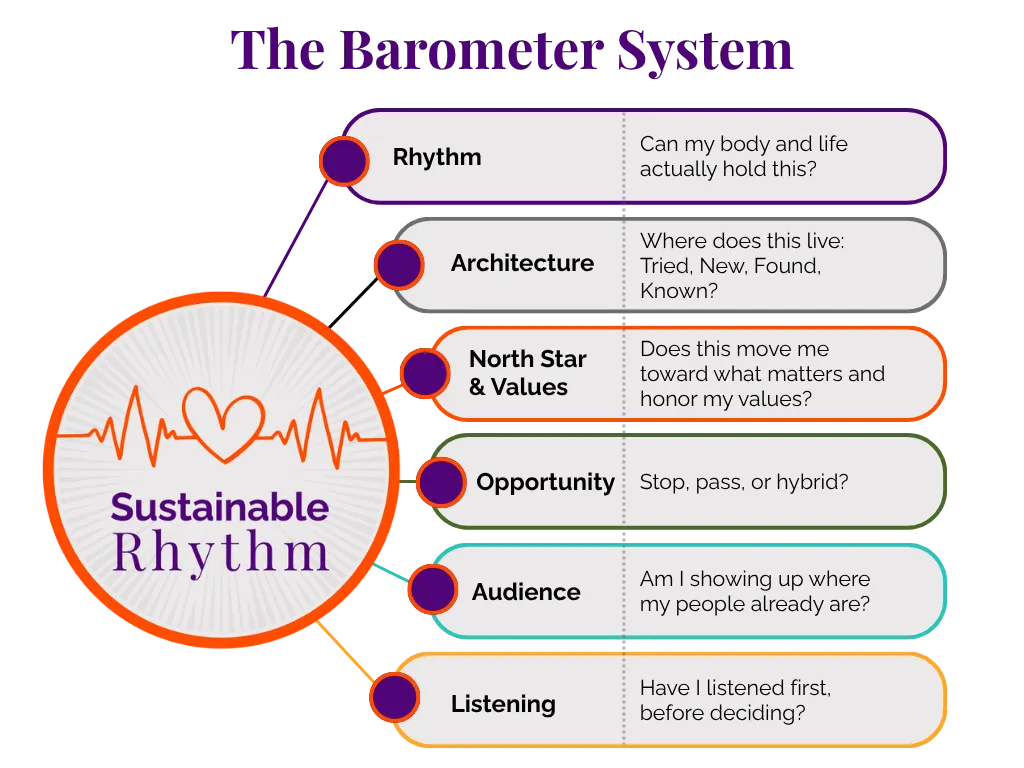
You will not always receive a perfect yes or no.
Sometimes the answer is: go all in.
Sometimes it is: stay with the plan.
Sometimes it is: find the hybrid—the version that protects your capacity while still allowing you to learn, test, and participate.
But the decision is no longer random.
It is rooted in the work you have already done.
Your Work Is Not a Pile of Loose Parts
This is what I hope you take from the series.
Your work is not a pile of disconnected ideas.
Your past is not a liability.
Your older content is not necessarily obsolete.
Your perceived failures are part of your story.
Your wisdom does not need to be repackaged into someone else’s formula to be valuable.
You are holding a body of work.
It’s alive with your stories, proof, patterns, relationships, and hard-earned perspective that can continue to serve people long after the original conversation, post, or platform has changed.
The work is to gather it.
Listen to it.
Curate it.
Build the structure around it.
Position it so the right people find it.
Show yourself so they get to know you through it.
Then keep returning to the compass.
Not because you need another system to manage.
Because you deserve a way to move through the next chapter without constantly abandoning yourself to keep up.
Call In the Fleet
We are often told that if we want a new chapter, we need to reinvent ourselves.
Burn it down. Start over. Become someone new.
That is unequivocal bullshit.
You are not starting over.
You are standing on everything you have spent a lifetime building.
Your past is not something to escape.
It is your fleet.
The work now is integration. Not reinvention.
Gather what matters.
Build the structure.
Be known for being YOU.
You are the cartographer now.
Mapping what comes next from the wisdom, stories, standards, and evidence you have already earned.
Tried & New + Found & Known is your Strategic Compass
This series is not the end of the work. It is the foundation.
Access all of the resources related to this series
The articles, livestreams, workbook prompts, and resources will remain here as a living library—something you can return to when you need to revisit a decision, gather your stories, improve a platform, clarify your audience, or choose what comes next.
The next step is to bring this work into the room together.
On Thursday, September 10 at 1:00 p.m. ET, I am hosting a 90-minute Working Roundtable to close this series. This is not a webinar.
Bring your workbook, your questions, the opportunity you are weighing, the content you cannot quite organize, or the part of your work you know needs attention.
We will use the Strategic Compass to begin connecting the dots.
You do not need to arrive with everything figured out.
You only need to bring what you have.
That is enough to begin.
-Donna


